Building Miransas Pulse from Scratch
A native macOS menubar monitor built without bloatware, with Objective-C, C, and launchd working together under the hood.
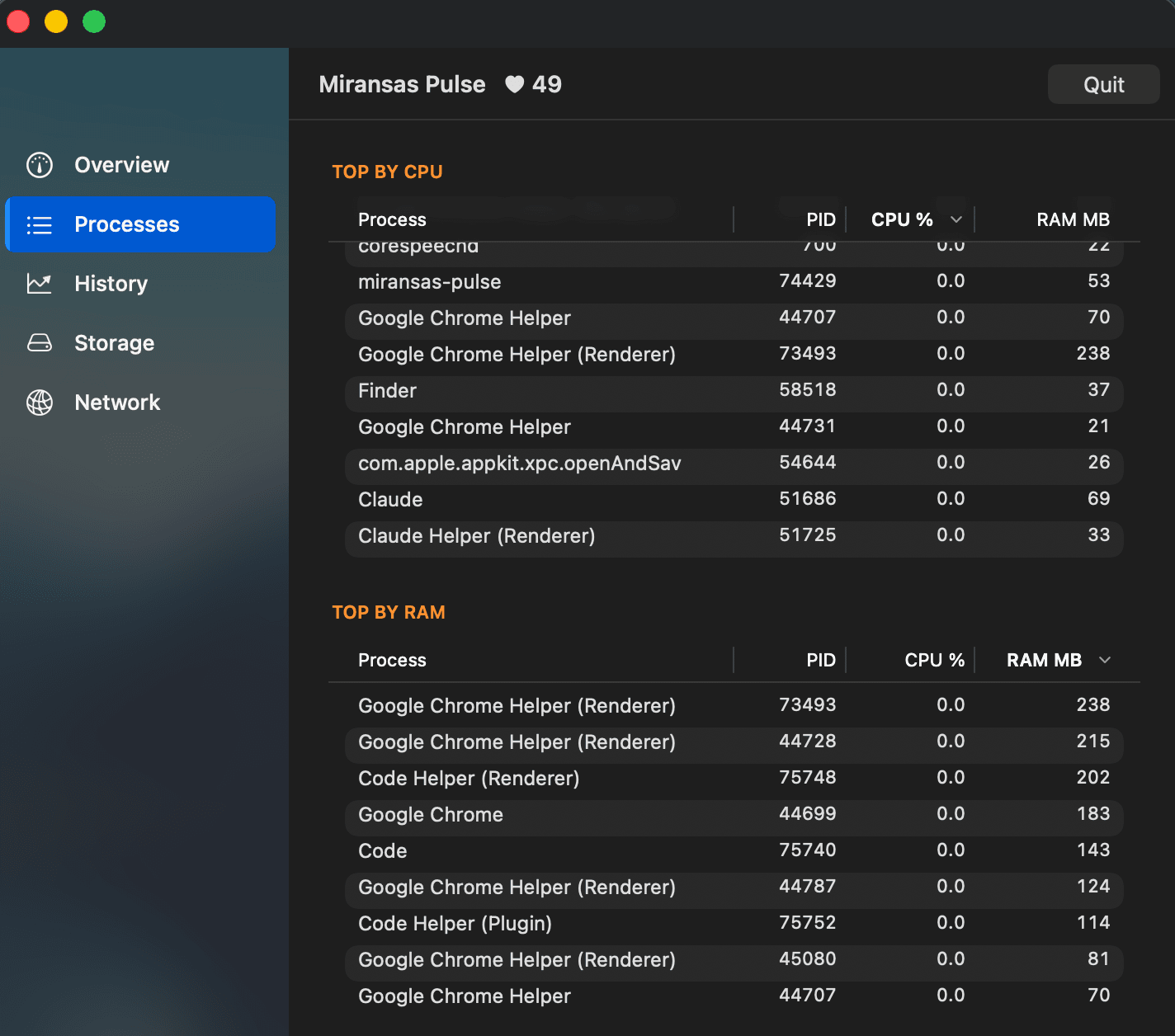
I wanted a system monitor that felt native, lightweight, and useful without becoming another bloated desktop app. That was the starting point for Miransas Pulse.
It is not just a dashboard. It is a small macOS-native tool that lives in the menubar, watches the machine, and gives you a quick read on CPU, memory, disk, and process activity without getting in the way.
Why build it this way
The goal was simple: avoid the usual app-layer bloat and build something directly on top of the platform. Instead of reaching for a heavy framework or a cross-platform shell, every major piece was implemented from scratch using the native macOS stack.
That meant working close to AppKit for the interface and using POSIX APIs for the performance-sensitive system metrics. The result is a tool that feels closer to the operating system than to a web wrapper pretending to be one.
The architecture
The project uses a hybrid structure. Roughly 80% of the implementation is in Objective-C, which handles the menubar integration, event loop, lifecycle, and native UI behavior. The remaining 20% is written in C for the low-level metric collection and process snapshot logic.
That split keeps the app responsive while making the performance-critical pieces explicit and predictable.
A background service, not just a window
One of the more interesting parts of the project is that Miransas Pulse does not behave like a normal desktop window. It runs as a native background service through macOS launchd, which gives it a few important properties:
- automatic startup at boot
- crash recovery without manual intervention
- a persistent presence that does not depend on a visible app window
That makes the experience feel more like a system utility than a one-off prototype.
What I learned
Building this by hand was a useful reminder that the simplest tools are often the hardest to make well. You end up learning a lot about the platform itself: event flow, lifecycle behavior, process monitoring, and the tradeoffs between abstraction and control.
It also made me think more seriously about the next step: bringing the same approach to Windows with native Win32 and C++ APIs.
What is next
The current direction is to keep the project focused on reliability and clarity. The long-term idea is to preserve the same philosophy while expanding the platform support and refining the experience around the metrics that matter most.